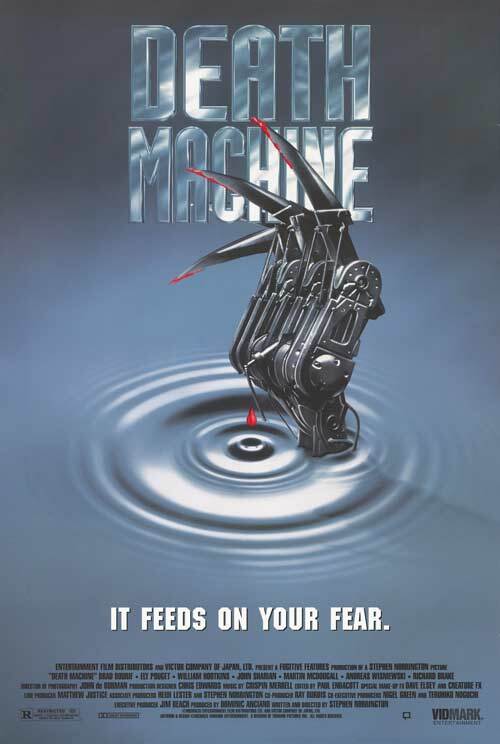
Death Machine does not feel like a polished science fiction film. It feels like something built in a sealed industrial room by people who had too many cables, too much metal and absolutely no interest in restraint.
That is part of its strange appeal.
Released in 1994, Stephen Norrington’s film belongs to a very specific moment in genre cinema: the last stretch of the analog future. The future imagined here is not clean, digital or frictionless. It does not glow with elegant interfaces. It does not float in the cloud. It grinds. It leaks. It sparks. It lives inside corporate corridors, underground labs, sealed elevators and rooms where every machine looks as if it could cut through bone.
This is cyberpunk before cyberpunk became a luxury aesthetic.
In Death Machine, technology still has weight. It is bolted together. It has hydraulic limbs, exposed mechanisms, hard surfaces and too much shadow. The film’s world feels less like a future society than a corporate weapons facility having a nervous breakdown. Everything is overdesigned, overstimulated and morally rotten.
At the center of that world is Chaank Armaments, a weapons corporation built on secrecy, intimidation and human disposability. This is not a company that accidentally creates monsters. It is a company whose entire business model depends on making violence more efficient. When something monstrous finally appears, it does not feel like a disruption of the system. It feels like the system becoming honest.
The plot is simple enough: corporate power, military technology, internal sabotage, a new executive trying to expose or control what is happening, and a deranged inventor whose creations have crossed the line between weapon and predator. But Death Machine is more interesting as an atmosphere than as a plot machine. Its story is not elegant. Its structure is not clean. What it has instead is pressure, texture and an almost comic-book level of industrial sickness.
The building itself becomes one of the film’s most important characters. Chaank is not just a location. It is a trap. The corridors, offices, control rooms and technical spaces feel like the inside of a company that has replaced ethics with machinery. Once the killer machine is loose, the building stops being architecture and becomes a maze built by the same logic that created the monster.
That is where the film begins to work.
The machine is not an outside threat. It is not an alien invasion. It is not a supernatural punishment. It is corporate violence turned physical. Chaank builds weapons, hides consequences, treats people as disposable and then discovers that its own logic has developed claws.
Jack Dante, played by Brad Dourif, is the unstable human core of this world.
Dante is not simply a mad scientist. That would be too clean. He is closer to a corrupted child with military funding. He builds death like other people build toys. He speaks in bursts, twitches through scenes, laughs at the wrong emotional temperature and seems to treat the entire company as an extension of his private damage.
Dourif does not play Dante with restraint. He plays him like a live wire wrapped in skin. The performance is grotesque, funny, unpleasant and sometimes almost too much — but Death Machine is not a film that needs subtlety from him. It needs voltage.
In a more controlled film, Dante might break the tone. Here, he defines it. His madness is not a side effect of the story. It is the film’s operating system. The machine may have the claws, but Dante is the corrupted imagination behind it.
What makes the character work is that he is both ridiculous and dangerous. He is pathetic, childish, obscene and technically brilliant. He is the kind of man a corporation tolerates because he produces results, until those results become impossible to contain. That is one of the film’s nastier ideas: institutions often do not fear monsters while they are useful.
They fear them only when they stop obeying.
The creature itself — the Warbeast, the death machine — is the film’s real body. It is not sleek. It is not beautiful. It is not a clean robot from a respectable science-fiction future. It feels like an industrial animal: part military hardware, part hydraulic nightmare, part childhood monster dragged into a weapons lab and made real.
That physicality matters.
Modern digital creatures often move too smoothly, too freely, too weightlessly. Death Machine comes from a different tradition. Its monster looks like it occupies space. It looks difficult to move, difficult to stop, difficult to survive in a narrow corridor. The fear does not come only from what it can do, but from the feeling that it has mass.
When it enters the film, the space changes. Corridors become hunting channels. Doors become delays rather than protection. The building shrinks around the characters. The machine turns corporate architecture into a slaughterhouse.
This is where Death Machine is at its strongest: as a pressure chamber.
The film understands that technological horror is not only about invention. It is about responsibility. It asks what happens when intelligence is separated from conscience, when engineering becomes an extension of aggression, and when a company builds tools of violence while pretending that violence itself is someone else’s problem.
Chaank Armaments is not evil because one man inside it is insane. It is evil because the system has room for him.
That distinction gives the film more bite than its surface chaos might suggest.
Death Machine is messy. There is no way around that. It is too long in some versions, too loud in many scenes and too overloaded with ideas to feel fully controlled. It throws cyberpunk, killer robot horror, black comedy, corporate satire, action cinema and comic-book grotesque into the same machine and lets the gears fight.
But that mess is also part of its identity.
This is not a film trying to be respectable. It has the energy of a debut feature that wants to push everything onto the screen before someone tells it to stop. It is excessive, yes. But it is also alive. You can feel the ambition pressing against the budget. You can feel the design work trying to compensate for narrative roughness. You can feel the film reaching for something bigger than its own limitations.
That is why it belongs in Hidden Tapes.
Not because it is a lost masterpiece. Not because it secretly outclasses the major genre films of its decade. It belongs here because it has the unstable charge that later cult films are made from. It has edges. It has dirt. It has too much personality to disappear completely.
There are better films. There are cleaner films. There are films that understand pacing, character development and tonal control far more gracefully.
But there are not many films that feel exactly like this.
Death Machine is a cyberpunk creature feature with the soul of an industrial accident. It borrows from the corporate paranoia of 1980s and 1990s science fiction, from the monster logic of slasher cinema, from the visual language of practical-effects horror and from the ugly dream of a future run by weapons manufacturers. It is derivative in places, but not empty. Its influences are visible, but they are processed through a very specific kind of grime.
The film’s best moments are not always its plot points. They are textures: the cold corporate spaces, the strange lighting, the mechanical movement, the sense of a building turning against its occupants, the grotesque presence of Dante, the feeling that every piece of technology in the frame was designed by someone who did not sleep enough.
It is a film about machines, but its most interesting quality is human sickness.
Dante is sick. Chaank is sick. The whole environment is sick. The machine is only the final symptom.
That is why the film still has some force. Under the noise and the excess, Death Machine understands that the monster is not created when the robot comes online. The monster is created much earlier — in boardrooms, budgets, military contracts and the decision to treat human life as a technical obstacle.
By the time the Warbeast starts hunting people, the moral disaster has already happened.
What remains is spectacle.
And as spectacle, Death Machine has a rough charm that modern genre cinema often lacks. It is not smooth. It is not tasteful. It is not afraid of looking ridiculous. But it is tactile. You can almost smell the metal, dust, sweat and burnt wiring. It has the quality of a film discovered on a damaged tape, played late at night, where the flaws become part of the transmission.
The most generous way to read Death Machine is not as a failed mainstream sci-fi action film, but as an artifact of an era when genre cinema still imagined the future as something physical and hostile. The future was not an app. It was a corridor. It was a locked door. It was a machine breathing somewhere in the dark.
That kind of future feels outdated now.
It also feels strangely refreshing.
Because Death Machine does not ask technology to be magical. It asks it to be dangerous. It asks what happens when tools inherit the violence of the people who designed them. It asks what kind of society would build a mechanical predator and call it progress.
The answer is simple.
A society not very different from ours.
For all its chaos, that is the reason Death Machine still deserves to be excavated. It is not elegant, but it has teeth. It is not profound in a quiet way, but it is louder than many better-behaved films. It does not always know when to stop, but it knows exactly what kind of nightmare it wants to be.
A corporate bunker.
A mad designer.
A machine with claws.
A future made of metal and bad decisions.
Death Machine is a messy machine, yes.
But one with real cult voltage.