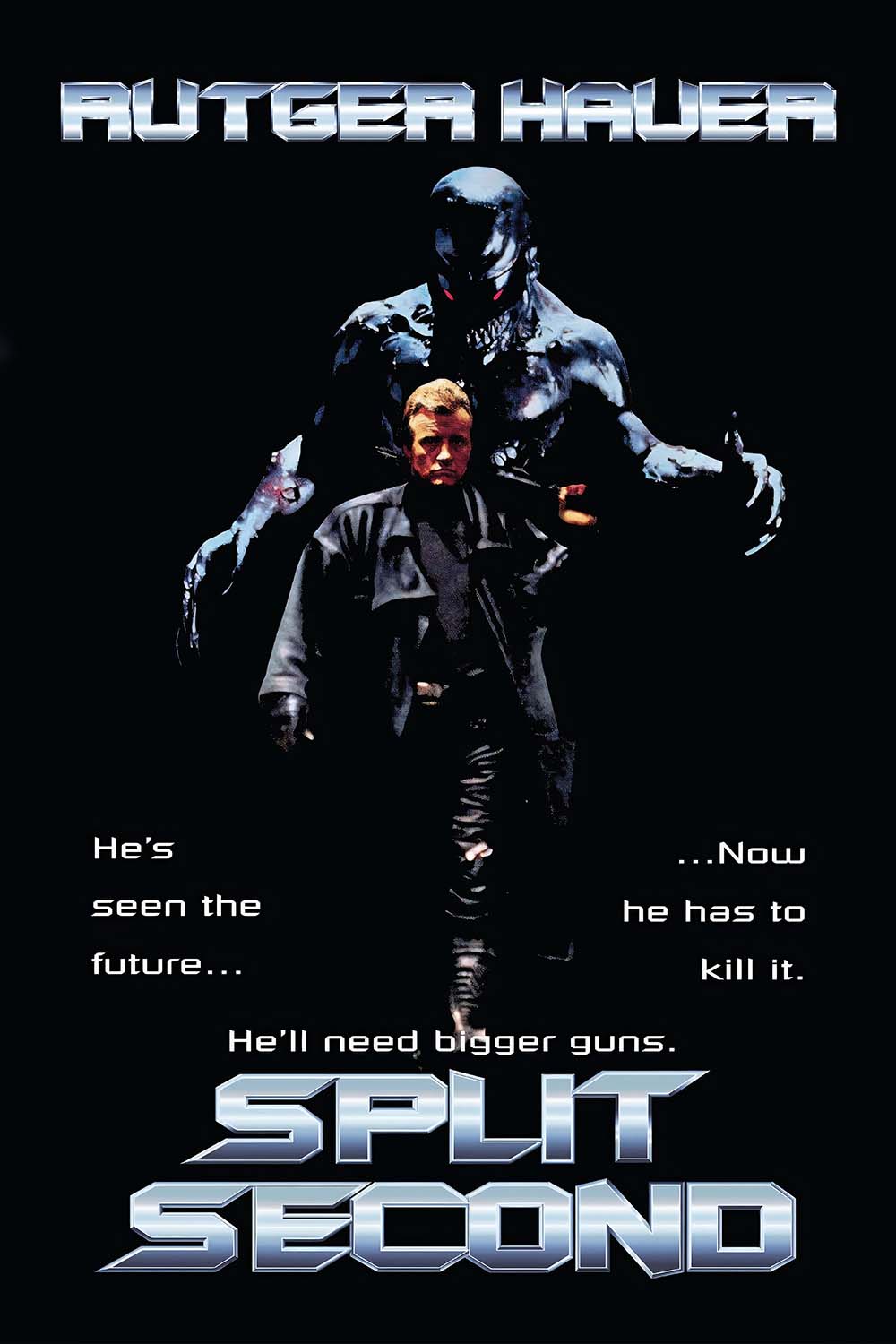
Split Second begins with an image of the future that now feels less like prediction and more like damaged memory.
London is flooded. The streets are wet. The air feels heavy. Everything looks as if it has been soaked for years and never properly dried. This is not the clean future of glass towers, perfect interfaces and frictionless technology. It is a future of dripping ceilings, bad lighting, police stations, sewer water, rats, cigarettes, cheap coffee and men who look as if they have not slept since the previous century.
That is the first thing the film gets right.
It understands that dystopia does not always need scale. It does not need endless cityscapes or expensive world-building. Sometimes it needs only texture. Water on the floor. Neon in the dark. A trench coat. A gun. A man walking through a city that seems to be rotting from the inside out.
Rutger Hauer plays Harley Stone, a detective so burnt out that he barely seems alive in the ordinary human sense. He is not simply tired. He is consumed. Stone is one of those genre characters who has been built almost entirely from trauma, caffeine, paranoia and instinct. He lives inside the case. He lives inside the wound. Everything else is just weather.
The case is simple on paper: a killer is tearing people apart and ripping out their hearts. Stone has history with this killer. Years earlier, his partner was murdered, and that death has never stopped happening in his head. Now the pattern has returned, and Stone moves through flooded London like a man following a signal only he can hear.
The beauty of Split Second is that the film never feels fully stable.
At first, it could almost be a serial-killer thriller. A damaged cop. A dead partner. A city in fear. Bodies. Symbols. Obsession. Then the movie starts sliding sideways into creature feature, dystopian action, occult horror, buddy-cop comedy and wet cyber-noir. None of those elements fit together cleanly. That is exactly why the film is interesting.
It feels assembled from incompatible genre parts and then left out in the rain.
Stone is paired with Dick Durkin, a more educated, nervous and rational detective who initially seems built to contrast Stone’s animal instincts. This is a familiar buddy-cop structure, but Split Second mutates it into something stranger. Durkin does not simply become the comic relief. He becomes a witness to Stone’s world. He begins the film as a man trying to apply order to a situation that has already moved beyond order.
That movement is important.
The film is not about a rational investigation slowly revealing the truth. It is about rationality being dragged through sewage until it starts carrying a bigger gun. Durkin’s transformation from controlled officer to terrified believer is one of the film’s more enjoyable genre pleasures. By the time the movie fully accepts its own absurdity, he has accepted it too.
And then there is the monster.
The creature in Split Second is not elegant. It does not belong to a refined mythology. It feels like a nightmare made by someone who had seen Alien, absorbed slasher cinema, read too many occult thrillers and decided that the future needed claws. It is partly serial killer, partly demon, partly genetic predator, partly comic-book beast. The film never explains it with enough discipline to make it fully convincing, but it gives the creature something more valuable than logic.
Presence.
The monster moves through the film like a pressure system. Even when it is off screen, the movie feels wet with it. The ripped-out hearts, the psychic connection, the sense that Stone is not only hunting it but being pulled toward it — all of this gives Split Second a strange pulse. The creature is not just a killer. It is the physical shape of Stone’s obsession.
That is why the film works better as atmosphere than as plot.
If you reduce Split Second to story mechanics, it is easy to dismiss. The script is uneven. The mythology is messy. The final act is blunt. Character relationships often feel more functional than deeply developed. The film throws ideas at the wall and does not always care which ones stick.
But this is not a movie you remember because of clean structure.
You remember the rain.
You remember Hauer’s face.
You remember the ridiculous amount of coffee.
You remember the flooded streets, the rats, the weapons, the leather, the wet concrete, the strange sense that London has become one giant basement. You remember a future that does not look advanced, only contaminated.
That is what gives Split Second its cult voltage.
The year is supposed to be 2008, imagined from the early 1990s. That detail gives the film a strange afterlife. Its future is already behind us, which makes it feel more ghostly than futuristic. It is not a prediction anymore. It is a dead future. A future that never happened, preserved on tape.
And dead futures are often more interesting than accurate ones.
Split Second belongs to a particular strain of early-1990s genre cinema that imagined tomorrow as a place of ecological collapse, urban decay and biological confusion. The city is not just dangerous. It is sick. The rain is not romantic. It is environmental failure. The water is not cleansing anything. It is making everything worse.
That is why the flooded London setting matters.
The film does not use water only as decoration. It uses it as mood. Every surface seems infected by it. The city feels lower than it should, closer to the sewer, closer to the animal. Stone is not walking through a futuristic metropolis. He is moving through the remains of civic confidence. The future has arrived, and it smells bad.
Rutger Hauer is perfect for this world.
He had a face that could carry both exhaustion and myth. In Split Second, he looks like a man who has survived too many genre films and brought all of them with him. There is something almost comic-book about Harley Stone — the coat, the gun, the stare, the appetite for coffee, the haunted one-liners — but Hauer gives him enough weight to stop him from becoming only a cartoon.
He plays Stone as a man whose nervous system has adapted to apocalypse.
That is not subtle acting. It does not need to be. Split Second is not a subtle film. It needs a lead actor who can make obsession look physical. Hauer does that. His Stone seems permanently tuned to a frequency nobody else can hear. He does not investigate the monster so much as vibrate toward it.
Kim Cattrall, as Michelle, gives the film a more human emotional line, though the movie does not always know how to use her with enough care. She is connected to Stone through grief, memory and desire, but the film is more interested in mood than intimacy. Still, her presence matters because she reminds us that Stone’s obsession is not abstract. It has damaged other people. It has a past. It has cost.
The supporting cast adds to the strange texture: police bureaucracy, nervous energy, urban weirdness, character-actor grit. Split Second often feels like a film filled with people who wandered in from different movies and somehow ended up trapped in the same flooded building.
That is part of the charm.
There is a version of this story that could have been cleaner, sharper and more coherent. It might also have been less memorable. The roughness of Split Second is not only a weakness. It is part of the artifact. This is a film with visible seams. You can feel rewrites, tonal shifts, production pressure and competing genre impulses. But those seams give it personality.
It is not smooth enough to disappear.
The creature design has the same quality. It is derivative, yes. It carries the obvious shadow of better-known monsters. But in the context of this film, that almost works. Split Second feels like a VHS-era dream assembled from whatever nightmares were already circulating in the culture: serial killers, climate panic, urban decay, genetic fear, demonic symbolism, police trauma and the lingering afterimage of Alien.
The film does not invent a new language.
It speaks a dirty dialect of familiar ones.
And sometimes that is enough.
The best way to approach Split Second is not to ask whether it is a great film. It is not. Not in the clean, classical sense. It is too clumsy, too loud, too uneven, too willing to solve problems with more guns and more shouting. But greatness is not the only reason films survive.
Some films survive because they have atmosphere.
Some survive because they have one perfect location.
Some survive because an actor gives the material more myth than it deserves.
Some survive because they feel like they were recorded from a future that rotted before it arrived.
Split Second survives for all of those reasons.
It has one of the essential qualities of cult cinema: it creates a world that continues beyond the edges of the frame. You can imagine other streets in this London. Other rooms. Other flooded tunnels. Other cases. Other broken people drinking coffee under failing lights while something moves beneath the city.
That sense of world is stronger than the screenplay.
It is stronger than the monster logic.
It is stronger than the film’s weaker jokes and rougher turns.
The atmosphere carries the damage.
By the final act, Split Second has mostly stopped pretending to be a mystery. It becomes a hunt. Guns, tunnels, water, teeth, shouting, movement. The film narrows into its most basic form: men with weapons descending into the dark to confront something that should not exist.
That simplicity works because the film has spent so much time making the city feel like a wound. The monster is not just hiding in London. It feels produced by London — by its water, its violence, its neglected spaces, its contaminated future. The creature is absurd, but the environment gives it permission to exist.
That is the secret of the film.
A monster movie can survive a ridiculous monster if the world around it believes in the monster.
Split Second believes.
Not intellectually, maybe. Not elegantly. But visually, texturally, atmospherically — completely. It believes in wet streets, in psychic scars, in predators moving through infrastructure, in men who drink too much coffee because sleep would mean thinking, in a city where the future arrived as dampness and decay.
There are better dystopian films.
There are better creature features.
There are better Rutger Hauer films.
But there are not many films that feel exactly like this: soaked, stupid, sincere, paranoid and alive with bad electricity.
That is why it belongs in Hidden Tapes.
Split Second is not a lost masterpiece. It is something more interesting for this shelf: a damaged genre object with a powerful smell. A film whose flaws are obvious, but whose mood refuses to leave. A film that understands, perhaps accidentally, that the future does not have to be plausible to be memorable.
It only has to be wet enough.
And Split Second is drowning.