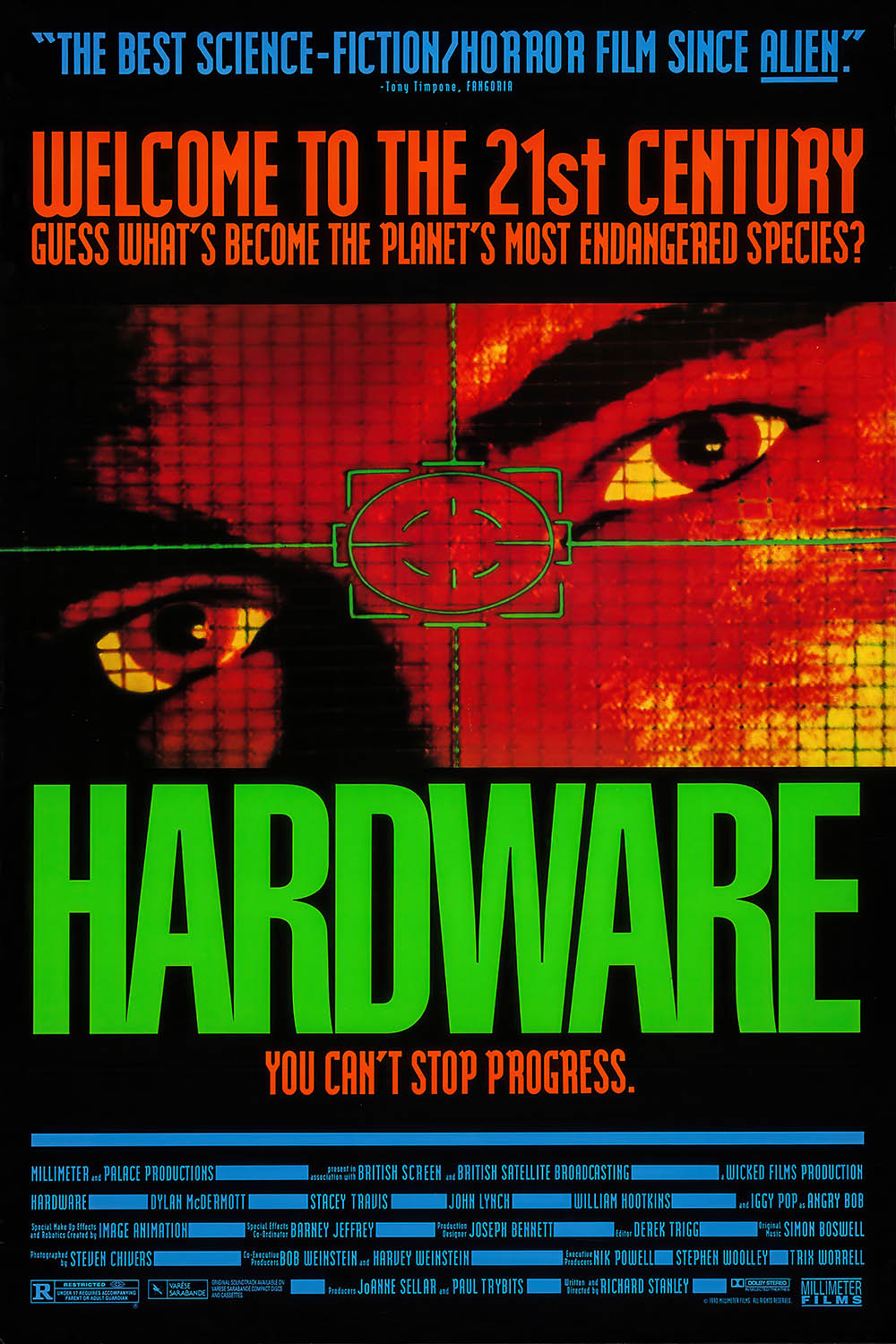
Hardware begins like a warning found in the dirt.
Not a clean warning. Not a message printed on a screen or delivered by some elegant machine intelligence. It begins as scrap. Metal in the desert. A broken head. A thing half-buried in a dead landscape, waiting to be mistaken for junk.
That is the first idea the film understands perfectly.
The future in Hardware is not new. It is not shining. It is not even properly futuristic. It looks used before it arrives. It looks scavenged, overheated, radioactive and exhausted. The world has already happened too much. Whatever civilization once promised has been reduced to markets, dust, machines, television noise, bad air and people trying to survive inside sealed rooms.
This is not science fiction as progress.
This is science fiction as corrosion.
Richard Stanley’s Hardware is thin if you describe it only as plot. A scavenger finds the remains of a military robot in the wasteland. Parts of that machine end up inside the apartment of an artist named Jill. The robot repairs itself. The apartment becomes a trap. The machine starts killing.
That is the story.
But Hardware is not interesting because of story.
It is interesting because it feels like an object.
A rusted object. A contaminated object. Something pulled from a future junkyard and placed under red light until it starts to breathe again. The film has the quality of a relic: part machine, part warning, part sculpture, part nightmare. It does not unfold so much as heat up.
The world outside Jill’s apartment feels dead, but not empty. It is filled with the residue of systems that have failed: military technology, population control, ecological collapse, media static, cheap consumer survival, black-market trade, authoritarian whispers, religious panic. The desert is not beautiful. It is irradiated. The city is not alive. It is functioning only because nobody has turned it off yet.
Everything in Hardware feels close to breakdown.
That texture is the film’s real strength.
The interiors are cramped, sweaty and overlit by color. The apartment is both shelter and prison, both studio and coffin. It is not a neutral location where horror happens. It is a pressure chamber. Jill builds art from metal, scraps and industrial remains, and the film surrounds her with the same materials. Her space already looks like a place where a machine could become a god or a corpse could become a sculpture.
So when the M.A.R.K. 13 begins to rebuild itself, the moment feels less like an invasion than a continuation.
The machine belongs there.
That is what makes Hardware more unsettling than its simple killer-robot premise might suggest. The robot does not enter a normal world and disrupt it. It emerges from the world’s existing logic. The society around it has already made violence ordinary. It has already made weapons sacred. It has already turned bodies into statistics and survival into routine exhaustion. The M.A.R.K. 13 is only the cleanest expression of that system: a thing designed to kill, repair itself and continue.
A machine that refuses death because death is its function.
The film’s title is perfect because it is brutally literal. Hardware. Tools. Parts. Metal. Equipment. Objects. The word has no romance. It reduces the future to material. Things you can hold. Things you can sell. Things that cut. Things that break. Things that keep working after the people who built them are gone.
And that is the nightmare.
Not that machines become human.
That machines remain perfectly themselves.
The M.A.R.K. 13 is not frightening because it has deep personality. It is frightening because it has none. It does not need hatred. It does not need madness. It does not need psychology. It is purpose without conscience. It is hardware with a mission. The film gives it enough presence to feel monstrous, but not enough humanity to make it comforting.
It is not evil.
It is worse.
It is operational.
That distinction matters. In many monster movies, the creature represents something irrational: hunger, rage, instinct, mutation, ancient curse. In Hardware, the monster feels like institutional violence that has survived the collapse of the institution. A military idea crawling through an apartment long after the political language around it has rotted away.
The future is dead, but the weapon still works.
There is something deeply ugly and beautiful in that.
Hardware is often remembered for its look, and rightly so. The film burns in reds, oranges, blacks and dirty blues. It feels sunburned and nocturnal at the same time. The desert looks like the end of history. The apartment looks like the inside of a fever. Screens glow. Metal reflects. Fans spin. Sweat gathers. Every surface seems to have absorbed heat, dust and bad dreams.
It is a film of surfaces, but not superficial ones.
Surfaces are meaning here.
Rust means history. Dust means abandonment. Metal means violence. Television static means the world still talking after it has stopped saying anything. The film’s images feel less designed for clarity than for contamination. They stain the viewer. They create mood before they create explanation.
That is why Hardware still works as a cult object.
It does not look interchangeable.
Many low-budget genre films try to hide their limitations. Hardware weaponizes them. The small scale becomes claustrophobia. The limited locations become ritual space. The mechanical creature becomes more memorable because it is surrounded by real texture. You can feel the weight of the objects. You can feel the heat in the room. You can feel the ugliness of a future assembled from things nobody wanted anymore.
This is one of the reasons practical effects matter in a film like this.
The machine has mass. It has edges. It looks like it would hurt to touch. It does not glide through the film as a smooth digital idea. It scrapes, clamps, rebuilds, pushes, cuts. The body horror is not about transformation in the usual sense. It is about contact. Human skin meeting industrial purpose. Flesh trapped in a room with something that understands only function.
The violence in Hardware is not always subtle, but subtlety is not the point.
The point is pressure.
Jill’s apartment becomes a miniature apocalypse. Outside, the world has already collapsed into heat, scarcity and paranoia. Inside, that collapse is repeated in one room. The global becomes domestic. The military becomes intimate. The machine that belongs to governments, armies and wastelands suddenly exists inside the private space of one woman.
That is one of the film’s strongest ideas.
Horror often works by bringing the outside in. Hardware brings the post-apocalyptic state into the apartment. It turns geopolitics into a home invasion. It turns military technology into something crawling through the place where someone sleeps, works, bathes and tries to remain human.
Jill is not just a victim in that space. She matters because she is an artist. She works with remnants. She rearranges dead material into new form. That makes her connection to the machine more interesting. The M.A.R.K. 13 also rearranges dead material into new form, but without imagination, without tenderness, without human ambiguity.
Jill creates from ruin.
The machine weaponizes ruin.
That contrast gives the film more force than a simple survival scenario. It is not only woman versus robot. It is human making versus military making. Art versus hardware. Improvisation versus programming. Fragile private life versus industrial death.
The film may not articulate this cleanly, but it feels it.
Hardware is often chaotic, and sometimes clumsy. Its dialogue can be blunt. Its characters can feel sketched rather than fully developed. Some sections drift more on mood than dramatic necessity. The film is not always elegant in pacing, and it is not built like a polished mainstream thriller.
But elegance would almost be wrong for it.
Hardware needs roughness. It needs the feeling of a film made from heat, music, sweat and obsession. It needs to feel slightly unstable, as if it might overload. Part of its identity comes from the sense that it is always close to becoming a music video, an art installation, a nightmare broadcast or a piece of industrial noise.
That instability is not a flaw to be removed.
It is the signal.
The film’s connection to industrial music and underground culture is part of its bloodstream. Hardware does not simply use sound as background. It lets sound become atmosphere. The world hums, pulses, grinds and broadcasts. Voices drift through radios and screens. Music seems to come from the same poisoned infrastructure as the machine itself.
Even silence feels mechanical.
This matters because Hardware is not only a visual film. It is a sensory one. It wants the viewer to feel trapped inside a hot room with too many cables, too much metal and something alive in the walls. It wants the future to sound like machinery left running after everyone responsible has disappeared.
That is a very specific kind of horror.
Not fear of the unknown.
Fear of the manufactured.
The M.A.R.K. 13 does not come from mystery. It comes from policy. From industry. From war. From men designing solutions to human beings. The film’s apocalyptic mood is not cosmic or supernatural. It is man-made. The desert, the weapons, the pollution, the surveillance, the scarcity — all of it feels like consequence.
Hardware is a film about consequence disguised as a killer-robot movie.
The world built the machine, lost control of it, forgot it, found it, sold it, displayed it, and then paid for it. That chain is absurd, but also perfectly logical. In a broken world, dangerous objects do not disappear. They circulate. They become commodities. They become art. They become accidents waiting for electricity.
This is why the opening scrap-metal premise works so well.
A weapon is found like treasure.
A death machine is treated like salvage.
The end of the world becomes interior decoration.
That is darkly funny, but also precise. Hardware understands that collapsed societies do not stop consuming. They consume ruins. They trade in leftovers. They decorate with fragments of their own destruction. The M.A.R.K. 13 is horrifying because it is mistaken for dead matter. It is treated as aesthetic material until its original purpose returns.
And once it returns, nothing in the apartment is innocent.
Tools become weapons. Art materials become traps. Domestic space becomes combat space. Light becomes alarm. Metal becomes predator. The room changes meaning around the machine, and that is where the film finds its best energy.
Hardware is strongest when it becomes almost abstract: red light, movement, panic, machine parts, sweat, screaming metal, close quarters. It does not need elaborate mythology in those moments. It needs only space and pressure. The apartment is small. The machine is relentless. The body is fragile. That is enough.
There is also something religious under the rust.
The M.A.R.K. 13 name carries apocalyptic weight, and the film keeps brushing against prophecy, judgment and end-times imagery. It does not become a clean religious allegory, and that is probably for the best. Instead, religion works like another layer of contamination. The future is not only technological and ecological. It is spiritual in a ruined way. People still look for signs. They still hear warnings. They still wrap machines in myth because the world has become too damaged to explain normally.
The robot becomes a kind of idol.
Not worshipped exactly, but charged with meaning. A metal head from the wasteland. A weapon named like scripture. A machine that returns from apparent death. A red-lit monster inside a room full of constructed objects. Hardware does not need to say this too loudly. The imagery does the work.
That is where Richard Stanley’s film is most powerful: not in narrative explanation, but in symbolic pressure.
Everything feels overloaded.
The colors are overloaded. The apartment is overloaded. The sound is overloaded. The machine is overloaded. The future is overloaded. Even the film’s influences are overloaded: Mad Max dust, cyberpunk decay, slasher structure, industrial music, comic-book violence, religious apocalypse, body horror, home-invasion tension.
It should collapse under all of that.
Somehow, it becomes more memorable because of it.
Hardware is not a clean genre exercise. It is too feverish for that. It is a film that treats science fiction like a contaminated room. It does not ask what technology will do for humanity. It asks what kind of objects humanity will leave behind after it has ruined everything else.
The answer is not comforting.
Weapons.
Screens.
Trash.
Noise.
And machines that still know how to kill.
That is why the film belongs in Hidden Tapes. It is not a perfect film. It is not a lost mainstream classic. It is not elegant enough, balanced enough or emotionally developed enough to be mistaken for one. But it has something more important for this shelf: identity.
You know when you are inside Hardware.
You know the color of the air.
You know the smell of the room.
You know the texture of the future.
Some films are remembered because they tell a story cleanly. Hardware is remembered because it leaves residue. It gets under the fingernails. It makes the future feel like something you would need to wash off your skin.
That is rare.
The film’s limitations are obvious, but they do not cancel its power. If anything, they help define it. Hardware feels like a transmission from a smaller, stranger, more tactile era of genre cinema — an era when a film could be built around mood, machine design, music, color and one claustrophobic nightmare space.
It does not feel focus-grouped.
It feels found.
Like a tape recovered from a room after the power failed.
Like a warning nobody processed in time.
Like a religious object made from scrap metal and bad decisions.
By the end, the M.A.R.K. 13 is more than a robot. It is the future reduced to function. It is the fantasy of control surviving after control itself has collapsed. It is war without an army, policy without a government, violence without ideology.
Just hardware.
Still working.
Still killing.
Still hot from the end of the world.
Hardware is not clean science fiction.
It is rust with a pulse.