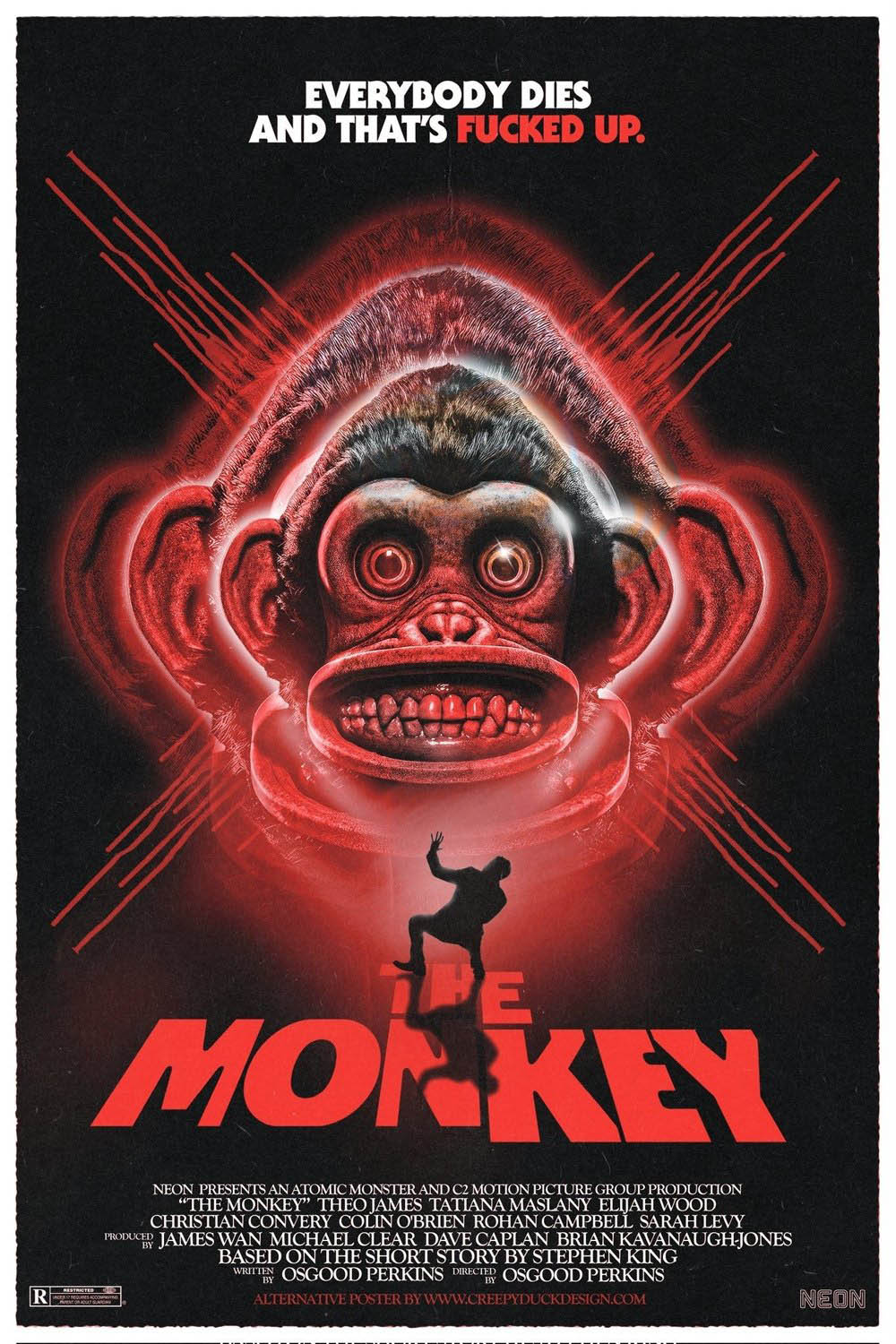
The Monkey is not interested in building elegant supernatural mythology. It does not whisper from the corner of the room, and it does not hide behind symbolic fog. Osgood Perkins takes a cursed toy monkey, winds the key, and lets death arrive like a bad joke told by the universe itself.
That is the film’s central idea and its greatest strength.
Based on Stephen King’s short story, The Monkey turns random death into both horror mechanism and comic principle. The monkey does not punish the guilty, reward the innocent or follow any moral design. It simply appears, activates and leaves destruction behind. In that sense, the film is less about a haunted object than about the unbearable fact that catastrophe often has no meaning at all.
Perkins understands this and leans into it. Instead of slow occult dread, he pushes the material toward gore, absurdity and fatalistic humor. The result is a film that feels lighter on its feet than some viewers may expect, but also nastier and more cynical in its view of fate. The joke is never just that people die horribly. The joke is that people keep trying to explain death as if explanation could protect them.
Theo James gives the film a strong center, grounding its more ridiculous turns with just enough emotional weight. The performances around him help maintain the balance between horror and grotesque comedy, and the film wisely avoids pretending it is more solemn than it really is. The Monkey works best when it embraces its identity as a cruel mechanism of escalation: key, drum, death, aftermath.
Visually, the film is less suffocating than Longlegs and less dreamlike than Perkins’ more atmospheric work, but that feels intentional. The Monkey is built around impact, rhythm and payoff. It wants momentum more than trance. That means some viewers may miss the deeper unease of Perkins’ more restrained direction, but the trade-off is a film that rarely goes flat. Even when it becomes uneven, it remains watchable because its basic engine is so simple and so effective.
What gives the film its extra bite is the way it connects random violence to family inheritance. Beneath the splatter and black humor sits a familiar Perkins concern: emotional damage passed between generations. The monkey is not just a cursed object. It is also a grotesque symbol of what survives inside a family long after reason has failed.
The Monkey does not aim for metaphysical terror. It aims for something ruder: the feeling that death is arbitrary, obscene and faintly ridiculous. That tone will divide viewers, but it is also what makes the film memorable. It is not trying to be sacred horror. It is trying to be a bad laugh at the edge of the abyss.
And for most of its runtime, it works.
The Monkey is messy in places, and not every tonal shift lands perfectly, but it understands its own mechanism. It knows that horror-comedy works best when the laughter does not cancel fear, but exposes how meaningless fear can feel in the face of random destruction. That gives the film a sharp identity and makes it more than just another Stephen King adaptation.
It is a death machine disguised as a toy.
And once it starts playing, nobody gets to pretend the world is ordered.